
THE ACCESSIBLE WATERWAYS ASSOCIATION hopes their work with healthcare professionals, and presence at Parliament, will spark a ripple effect for health provision, and access to it, for boaters.
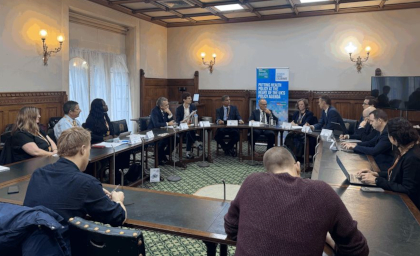
Following their attendance at Westminster Hall in October, where they made a presentation to the All-Party Parliamentary Health Group (APPG), the Accessible Waterways Association are joining forces with leading influential figures to continue to advance their mission for access to healthcare for those living and travelling on canals and waterways across the UK.
 Issues boaters face
Tim Clarke was also accompanied by Dr Jane Jervis from Keele University, who they met at Huddlesford Heritage Gathering back in September, and spoke about the issues boaters in particular face trying to see a GP.
Dr Jane is conducting a study of people who live on canal boats about their experiences of NHS services, including going to the GP or Pharmacy. This, and the committee session, were in response to issues they raised back in May 2024 with the aim of discussing ‘Improving access to primary care services’, with focus on those who cannot get timely, appropriate first-contact care and why?'
Tim explained:
“Experience shows that discrimination, whether accidental or deliberate, is a problem. Boaters’ health care suffers when they cannot access the services they are entitled to. Having now got the opportunity to have our voice heard at this level, we shall continue to press for these concerns to be addressed.”
Tim also raised the point that even if a boater does find a doctor willing to accept them, this does not necessarily mean they will be able to access the necessary health records. This is because the NHS is fragmented, with different providers using various systems which do not communicate with each other.
No access to information
Neither opticians nor dentists have access to this information either. This in turn can lead to problems if important medical information is not passed on. Hopefully, the development of the NHS app, which is intended to coordinate all medical information, will eventually address this situation.
However, the problem extends even further. A shocking statistic quoted at the meeting stated that 'recent data shows over 57,000 A&E attendances by people of no fixed abode in 2021/22, suggesting a gap in access to primary care'. Obviously this results in increased costs to an already stretched NHS.
Tim adds:
"The bottom line is really accountability. In our attempts to raise the boaters’ health care problems, we kept running against a brick wall. Although the NHS is supposed to be a ‘National Health Service’, it appears that in practice it is administered at a local level. Our attempts to get answers from NHS England simply resulted, on many occasions, being unhelpfully told to ‘contact your local integrated care board (ICB) for complaints about primary care services (GPs, dentists, opticians or pharmacists) and secondary care, such as hospital care, mental health services, out-of-hours services, NHS 111 and community services like district nursing.’ Every ICB will have its own complaints procedure, which is often displayed on its website.”
A national problem
Obviously, as this is a national problem, this is an unacceptable response but does support our view that the NHS is not nationally regulated. One would have thought that, having brought this to the attention of NHS England at this time, someone would have sat up and taken notice.
There is an online questionnaire, which can be accessed below. This study has already revealed that even if a boater has a fixed mooring, that does not necessarily guarantee access. At least one health centre has refused on the grounds that it is not a bricks and mortar address.
As they have documented on their Access Healthcare page, boaters’ health care needs should already be being met, if providers simply followed the existing regulations. Yet all the evidence suggests that this is clearly not the case in many instances.
The Accessible Waterways team have recently started talking to:
University College London, Dom Hall (People and Communities Engagement Specialist at NHS Bath and North East Somerset, Swindon and Wiltshire Integrated Care Board) and have also teamed up with Fred Barker, GPST4 at Bethnal Green Health Centre, Academic Clinical Fellow at QMUL, who is also a fellow boater.
They have now created a form on their website:
https://www.awa-uk.org.uk/health-care-refusal-information-form/ for boaters to share any negative experiences so feel free to contribute your experiences.
facebook.com/share/p/17pLrU39ML