
HOW SCRAPPING MARKETING/PR could have saved £76 millions. writes Alan Yates.
It started as a simple doodle on a spreadsheet while Storm Austen rocked the boat and puddled another towpath.
Staggering sums swallowed up
As the rain lashed down outside, I got to thinking about the state of our 2,000 miles canal network—and the sheer, staggering sums being swallowed up by catastrophic embankment breaches. The maths, as it turns out, is remarkably straightforward.
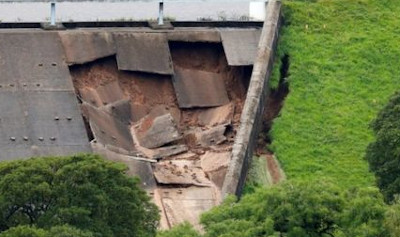 Over the last 12 years under the Canal & River Trust (CRT), major structural failures—from Whaley Bridge’s Toddbrook spillway (£56.2M), pictured, and Whitchurch (£10M), down to Middlewich, Pollington, Gilwern, and Dutton—have cost an eye-watering £76.8 million in emergency engineering. Heavy earthworks, Tier 1 contractors, sheet piling, and 24/7 over-pumping don't come cheap once a wall collapses or an embankment washes into a field.
Yet during that exact same 12 years window, central marketing, PR, branding, and communications expenditure has quietly consumed roughly £8.5 million every single year—totalling a cool £102 million.
What if we did a straight swap?
Reallocating that £8.5 million marketing budget would fully fund 150 tech-enabled lengthsmen across the entire 2,000-mile network. Each beat (around 13 miles) would get a dedicated local worker equipped with an e-cargo bike, hand tools, and a sub-250g inspection drone for rapid bank checks.
Compare the two options over a 12-year period:
The Status Quo: Spend £102 millions on marketing, plus £76.8 million fixing disaster zones after they burst. Total: £178.8 millions. The Lengthsman Model: Spend £102 millions funding direct field labour to pull saplings off earthworks and inspect for leakage before embankments fail. Total: £102 million.
The net difference? A £76.8 million saving.
Summary
It isn't a complex financial riddle; it’s a fundamental choice between central corporate overheads and continuous, preventative civil care on the ground.
When a simple back-of-the-napkin doodle reveals a £76M gap, it becomes hard to see the current crisis as a simple lack of funding.
It looks a lot more like a failure of management priorities.