
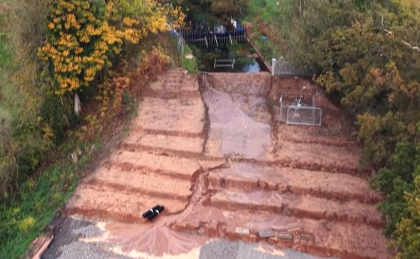
A PUMP STOPPED WORKING overnight causing an earth dam to breach causing flooding and consequential damage
This was to the earth steps at the north end of the Whitchurch breach site, writes Alan Yates.
This really comes as no surprise as leaves are coming off the trees and blocking pump inlets.
A proper dam doesn't need a diesel engine
There was a time when canal maintenance workers understood a simple principle: if you wanted to keep water out of a section of canal, you built a dam that actually held it back.
 Not a collection of scaffolding poles, tarpaulins and plastic sheeting, supported by pumps running continuously in the background, but a proper hardcore bund incorporating an impermeable clay core.
The problem with temporary scaffold and tarpaulin dams is simple. THEY LEAK.
Water finds its way beneath the sheeting, around the edges and through gaps between the dam and the irregular canal bed and banks.
Consequently, the accumulating leakage must be pumped away. That means pumps, generators, diesel fuel and regular visits to ensure everything is still working.
At this time of year, the problems multiply. Fallen leaves, dying vegetation and floating weeds collect around pump intakes, restricting the flow and sometimes blocking them completely.
Then there are the generators. They need refuelling, servicing and occasional repairs. Should a generator fail or a pump become blocked, the water continues to enter regardless.
For a short-term operation lasting a day or two, such arrangements may be perfectly reasonable. But when a canal is expected to remain dewatered for months, the disadvantages (and risks) become increasingly obvious.
The traditional solution
Ask any experienced canal worker how to construct a dam intended to remain in place for an extended period, and the answer will probably involve a substantial hardcore bund with a properly compacted clay core.
The hardcore provides the mechanical strength, while the clay provides the watertight barrier. Properly keyed into the canal bed and banks, the clay core reduces seepage to a minimum.
There may still be some water to remove following heavy rainfall or groundwater ingress, but that is very different from continuously pumping away water leaking through a temporary dam.
A properly constructed bund has no moving parts, requires no electricity and consumes no diesel.
Of course, scaffolding dams have their place, particularly for short-term work or where access makes a substantial bund impractical.
Deserves serious consideration
But where a canal is to remain isolated for months, surely a conventional clay-cored bund deserves serious consideration.
The original canal engineers didn't have portable generators and submersible pumps to fall back upon. They had to build dams that actually held back the water.
Perhaps there is something to be learned from their experience.
After all, the cheapest pump to operate is the one you don't need.
Credit to Kieran for his excellent drone footage.