
Why do 200 years old canal structures outlast their modern concrete equivalents?
Asks Ralph Freeman BSc(Hons)
There is a fashionable trend emerging amongst today's armchair engineers to sneer at the work of pioneering Georgian and Victorian civil engineers. Equipped with supercomputers, finite element analysis, and sophisticated theories of soil mechanics, some individuals look back on figures like Thomas Telford, William Jessop, and John Rennie and dismiss them, in effect, as lucky 'jerry builders' who succeeded only through brute force and guesswork.
Life of 200+ years
Yet, as canal boaters navigate structures that have stood firm for well over two centuries, a glaring question presents itself: if modern computer-modelled engineering is so superior, why are so many 20th-century megastructures falling apart after just fifty years?
Look at the record of mid-to-late 20th-century engineering. In 1984, the earth/clay Carsington Reservoir dam in Derbyshire suffered a sudden, massive failure before it was even completed. Equipped with all the modern geotechnical theory of the day, designers miscalculated soil mechanics and shear stress, causing a 500 metre section of earthwork to slip and collapse.
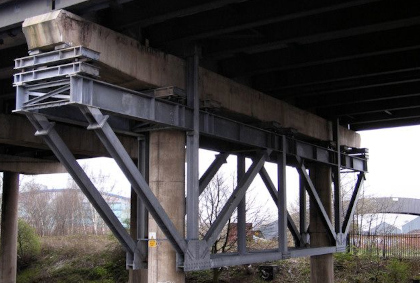 Limited life concrete
Consider our road networks. Tinsley Viaduct on the M1, built in the late 1960s, required major structural strengthening and lane restrictions within a fraction of its planned design life due to fundamental flaws in box-girder theory and load predictions. Birmingham’s famous 'Spaghetti Junction' (Gravelly Hill) and countless counter tensioned concrete bridges built in the 60s/70s now suffer from internal steel tendon corrosion, crumbling concrete, and continuous expensive repairs. Massive infrastructure projects built using modern 'optimum efficiency' algorithms are proving frail, brittle, and notoriously short-lived. Photograph taken from the Birmingham & Fazeley Canal.
So, why do Telford’s Pontcysyllte Aqueduct, Jessop’s earthworks, and the thousands of stone/brick bridges and locks across the British canal network endure, while modern concrete equivalents disintegrate?
It boils down to two core principles that the early pioneers understood intuitively, but which modern cost-cutting and computer optimisation have discarded:
Mastery of physical modelling and empirical rules of thumb
The canal builders did not design blindly; they built their understanding on physical experimentation and vast empirical observation. Lacking digital crunching power, Telford famously built physical scale models and tested material stress limits to destruction—such as his prototype testing of cast-iron troughs for Pontcysyllte or testing full-scale iron links for the Menai Suspension Bridge.
Engineers developed robust rules of thumb based on decades of real-world trial and error. They understood the behaviour of puddle clay, hydraulic lime mortar, and masonry batter angles because they watched how materials performed over time under real operational conditions, rather than relying on theoretical equations that fail to account for site anomalies.
Generous factors of safety
Modern computer software allows engineers to optimise a structure to use the absolute minimum amount of material required to satisfy a theoretical load. (This is of course the primary goal set by the bean-counters)
While mathematically efficient, it leaves zero tolerance for unexpected ground movement, material variance, or centuries of environmental weathering.
In contrast, Georgian and Victorian engineers 'knew what they didn't know'. Because they could not map every variable within a soil bed or stress vector inside a iron casting, they applied generous factors of safety—often factors of 3 to 5 higher than strictly necessary. They over-engineered by design. That 'extra' masonry, the extra thickness in a cast-iron plate, and the generous dimensions of canal embankments provided an immense reservoir of structural resilience.
When a modern concrete bridge experiences a minor unexpected shift, the optimised margins evaporate, and structural failure looms. When a 200 year old stone lock or aqueduct experiences a shift, the massive factor of safety absorbs the stress, allowing the structure to keep functioning.
The great canal builders were not crude builders guessing in the dark. They were empirical engineers of the highest order. By combining careful physical testing, observational data, and a healthy respect for the unpredictable forces of nature, they created infrastructure that outlives the computer-optimised creations of today.
Next time you pass through a 200 year old lock or cross a Georgian aqueduct, remember: you are not looking at outdated technology. You are looking at a masterclass in structural resilience that modern engineering would do well to copy.