
CONTRACTORS KEIR HAVE hit a problem at Whitchchurch breach in that they have unexpectedly discovered clay 'soft spots', writes Ralph Freeman.
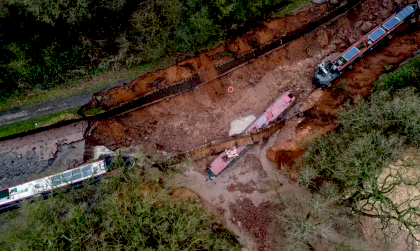 This is immediately above the two culverts that run under the embankment at the site of the breach.
This shows a lack of canal experience and a failure to do their homework too? No matter, it'll just go on the bill .
Canal construction over culverts:
When a canal crosses an existing watercourse via an under-bridge or culvert, maintaining the watertight lining of the canal bed above the structure is critical.
The Construction Practice
Continuous Waterproof Seal:
Canal engineers (such as James Brindley and Thomas Telford) lined the bed and banks of canals with puddle clay—a well-worked, plastic mixture of clay, water, and sand/gravel. Where a culvert passed underneath, this puddle clay lining was carried directly over the top of the culvert's masonry or brick arch ring to ensure the canal envelope remained fully watertight and uninterrupted.
Protection Layer:
The culvert arch itself was typically backfilled and levelled off with rammed earth or fine material first, over which a thick blanket (often 1ft to 3ft thick) of worked puddle clay was laid.
Structural Load Separation:
In addition to waterproofing, the clay blanket cushioned the masonry structure below, distributing the hydraulic pressure and weight of the water column evenly across the arch ring without pinpoint loading.
Failure to properly puddle over or around a culvert—or deterioration of the clay layer over time through drying out or erosion—is a primary cause of canal breaches, as leaking canal water quickly scours out surrounding fill around the culvert barrel.