
GREATER ENFORCEMENT POWERS for an unaccountable charity is not the answer to anti-social behaviour, states the National Bargee Travellers Association (NBTA).
Recent reports of littering and anti-social behaviour on the Kennet & Avon have been seized upon by Canal & River Trust (CRT)—the charity responsible for managing much of the UK’s over 2, 000 miles of navigable inland waterways—as supposed evidence of the need for this unaccountable, struggling charity to be granted sweeping draconian enforcement powers.
Incorrect, opportunistic and deeply unsettling
The National Bargee Travellers Association—who represent itinerant boaters living on the UK's waterways—have responded explaining why CRT’s argument is incorrect, opportunistic and deeply unsettling:
There is no doubt that litter and anti-social behaviour more broadly, is a major issue in the UK.
But what would you say if because someone started fly-tipping on your country lane, your entire village was forced to start wearing tracking devices, while bailiffs threatened to take your home because you’d failed to pay a fine? Under the guise of 'cleaning up the waterways', CRT is pushing to introduce a whole raft of new powers through parliament that will effectively turn canals into an open-air prison…
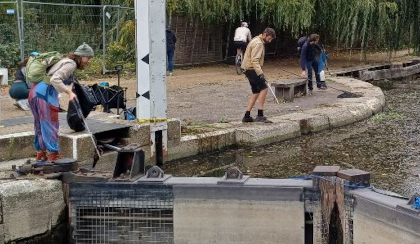
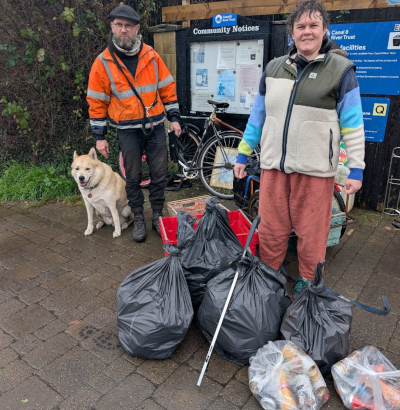 Whether it’s criminal gangs getting away with illegal toxic dumps, people fly-tipping in the mountains of Wales or city streets with overflowing bins—not enough is being done to fix the blight of litter and pollution in the UK. In some corners of the country, communities have been stepping up to try to combat the problem, including the boating community themselves, who are engaged in an ongoing series of towpath clean-ups through the ‘Nomadic Litterpickers’ campaign.
However, CRT is seeking an entirely different solution to the issue of litter on the canal: draconian new powers that will affect every boater in the UK. (The picture shows boaters litter-picking from a trust's area at Trowbridge, and a further litter-picking shown below.)
New 'enforcement powers'
Rather than address the root causes, CRT is agitating for new 'enforcement' powers that will allow them to dictate boaters’ cruising ranges, continue to raise costs for licence holders and forcibly dispossess people of their homes if they’re unable to comply. How a suite of new draconian powers—without any oversight—is going to dissuade the country’s litter bugs is not clear, and never explained.
In a recent debate in Parliament (21st January 2026), the Liberal Democrat Member for Bath, Wera Hobhouse, took the opportunity to rehash many of the CRT’s tired talking points including blaming boaters for litter along her local canal, rather than the significant reduction in bins and other waste facilities by the Trust. After sharing her concerns about litter and pollution in her constituency, Hobhouse acknowledged that there are government agencies already empowered and funded to deal with the issues she outlines:
 “…the Environment Agency is responsible for pollution and environmental protection, local authorities oversee byelaws relating to littering and antisocial behaviour, and the police retain responsibility for criminal offences.”
Hobhouse then went on to suggest (in a speech which appeared to have been ghost-written by CRT’s management) that as these issues remain unresolved in Bath, due to overlaps in remit by these agencies, it follows that CRT—a quango entrusted to maintain our canals and waterways—should be supported in its lobbying for unnecessary new legislation.
While the MP for Bath did share her intention to:
Enforcement
“...bring together the Canal & River Trust, the police, the Environment Agency and the local authority to improve local co-ordination and enforcement.”
…it appears she (or the CRT) has already decided that this won’t actually fix the issue. Hobhouse said in her statement in parliament:
"But let me make it clear that, although better collaboration is essential, this alone is not enough. To genuinely improve enforcement on our waterways—and I echo the calls of the Canal & River Trust in this regard—we must see meaningful reform of the law."
Under the guise of dealing with small challenges that the whole country is grappling with in every community, the CRT is pushing to retract decades-long rights of navigation and to slap a bunch of unnecessary extra burdens on ordinary citizens. Among its many plans, CRT wants the power to install tracking devices on private citizens’ boats, raising serious questions over GDPR and the right to privacy, and the right to use ‘reasonable force’ in enforcement proceedings, raising the spectre of unaccountable private contractors using violence to remove people from their homes on the water.
Restrict number of boats
CRT also has plans on the table to restrict the number of boats allowed in areas that are 'popular', making it possible to buy your way into space that is meant to be public. Some of these now 'popular' areas were no-go zones not that long ago, before boats brought life, community and safety to areas people were once afraid to walk through.
Frustratingly, the Member for Bath admits there are clear pre-existing pathways to fix the problems she raises in Parliament; these just require collaboration.
Before CRT seeks government support to radically change the lives of thousands of boaters with draconian new legislation and unchecked power, the boating community suggests that all these agencies work together with the power and resources they already have, held by the relevant and appropriate authorities.
The boater community—the vast majority of whom are law-abiding, community-minded citizens, and who are more concerned than anyone that anti-social behaviour and littering on the waterways they call home is dealt with—is calling on all politicians, including the MP for Bath, not to be hoodwinked into supporting this ploy for more authoritarian powers to a quango which—unlike the police and the Environment Agency—has no direct government oversight at all.
Just two weeks ago, CRT released a statement applauding its successful eviction of an encampment in London that was deemed illegal and unsightly.
‘Matthew Aymes, our national licensing compliance & enforcement manager, told:
“This structure and the individuals associated with it were causing significant disruption to the local community and law-abiding boaters nearby. I’m delighted that we have been able to use the appropriate legal processes to remove it.’
Within scope of current legislation
Clearly, tidying up pockets of the waterways—as Mrs Hobhouse wants to see in her constituency of Bath—is entirely possible within the scope of current legislation and in conjunction with government agencies empowered and properly trained to achieve this.
The recommendations by CRT’s self-appointed 'independent' commission on boat licensing will have negative economic, social, educational and health impacts on a huge community of people—from students to families to pensioners—almost immediately. Worse still, empowering a charity already failing to manage their remit with more responsibilities could see the waterways decline even further.
Handing a raft of new powers to a charity at arm’s length from the government that will punish an entire community is a gross overreach and emblematic of a slide towards authoritarianism we’re seeing across the world right now. It must be rejected. Boaters must not be the scapegoat for the CRT’s failure to work with government agencies to enforce laws that already exist, from the local bylaws on littering to the British Waterways Act 1995.